 micromobilitybiz Delivering news updates to the micromobility industry, focusing on e-bikes, e-scooters and green transport

In this guest feature, Phillip Lucas explores drivers for change which impact transport choices, when choices are actually made available, not simply reinforcing legacy design-entrenched ‘decision making’ (when is a choice not a choice?).
What’s particularly interesting here: Lucas provides a well-travelled, extremely knowledgeable, European view of UK transport behaviour change.
Why so interesting?
Much of today’s active travel media coverage tends to focus on and reference European successes, shifting and supporting changes in transport habits.
Here we have a European view on UK transport choices and behaviour change.
Is City of London cycling up because of a “war on cars”? More like “A war on buses” (and that too is a nonsensical misreading).
How is London’s mobility culture changing?
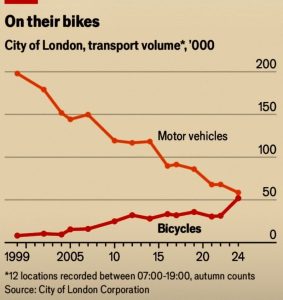 A widely circulated chart shows car traffic falling sharply in the City of London, while cycling appears to surge dramatically. At first glance, some interpret the visibly greater fall in car use vs bike growth as evidence of a campaign to force cars out of the city. They then think, surely this was from the suppression of cars? But that reading misses the bigger picture.
The rise in cycling is real—and hugely positive. Londoners are choosing faster, cleaner, and more agile ways to get around. And yes, car use has declined, partly due to ULEZ and other policies, but mostly because the city is changing. Commuting habits, travel demand, and urban lifestyles are all shifting.
What we’re seeing isn’t so much coercion as it is adaptation. An argument for plain coercion would require the city itself to be identical to what it was before COVID—and it isn’t. The playing field has changed.
To understand this properly, we need to zoom out.
The chart in question only shows the Square Mile—a dense commuter zone of just 2.9 km² with fewer than 10,000 residents.
- It’s not representative of Greater London, which spans over 1,572 km² and is home to around 8.5 million people.
- It’s a textbook example of a “last mile” setting, where agile forms of mobility like bicycles and e-scooters naturally outperform combustion vehicles bogged down by congestion, without even considering regulation and limited parking.
What works there tells us something, but not everything. To grasp the full picture, we must look at Greater London as a whole.
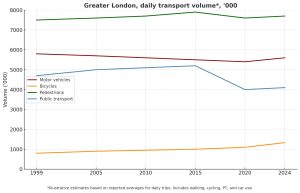
And when we do, we see that there is a broader transport diversification trend—but not one as steep as the popular graph suggests.
- Cycling is up.
- Walking is stable.
- Driving is down.
Cycling across Greater London hit 1.33 million daily journeys in 2024—a 26% or 200,000 trip increase over 2019. At the same time, car driver trips dropped from 5.8 to 5.6 million per day—a reduction of around 200,000 daily trips, or about 3.4%.
So yes—cycling has grown by about as much as driving has declined, and both trends are real in absolute and percentage terms. But this isn’t proof of cars being persecuted—it’s simply part of a wider behavioural shift.

And here’s the key: mobility overall is down, and that’s largely due to the 11% drop in public transport use, especially buses.
Over a million daily transit trips have disappeared since 2019. And yet—there’s no talk of a “war on buses.” Nor should there be. It’s not about banning anything—it’s about how people choose to move in a city that itself is shifting. Behaviour has changed. The workplace has changed. People are still moving, just differently.
Much of cycling’s growth may well have come from former transit users—people seeking more speed, flexibility, and affordability in their daily travel.
Perhaps some drivers have stepped away too, nudged by ULEZ expansion, congestion, or rising fuel prices. But they haven’t been replaced by ideology. They’ve been replaced by viable alternatives—more agile, more practical, and in many cases, simply better suited to how London now functions.
And those alternatives are backed by investment.
Since 2016, London’s cycle network has grown from 90 to over 400 kilometres. By 2024, more than 27% of Londoners lived within 400 metres of it. But with 14’500km of road, I’d say over 99% of Londoners live within 40 metres of a road (even in LTNs or ULEZ).
For every cycling trip, there are still nearly five made by car, while there is a 1:35 bike: car provision ratio. The bias is clear: Cars remain deeply embedded in the city’s design. This isn’t elimination—it’s gentle diversification. So these bike paths aren’t symbolic gestures—they’re working infrastructure. That’s what a gradual shift looks like—purposeful, proportionate, and rooted in expanding options, not eliminating them.
As for the Square Mile itself: yes, traffic has dropped 20% since 2019, and cycling now makes up 27% of vehicle movements. But it’s not just mobility that’s changed—the purpose of the place is changing too. Daytime footfall remains far below pre-COVID levels, but evening activity is rebounding faster, reaching around two-thirds of 2019 levels. The City is shifting from a commuter hub to a destination: a place to visit, eat, gather, and enjoy. It is reclaiming its importance as a place to visit by choice, more than as a place to work.
 The Square Mile may resemble a pedestrianised European city, but Greater London is still fundamentally structured around the car. And it’s precisely this car-centric design that makes life frustrating for the very people who choose to drive, because too many others feel forced to make the same choice.
Perhaps that’s because, beyond the bus and the Tube, there’s still a lack of widespread, viable options for longer trips that go beyond the first or last mile (while e-bikes can easily bridge 10-mile distances – a radius as large as the M25).
Until the alternatives scale, the result isn’t car freedom—it’s car dependency. I felt this on a recent trip to London (I even saw Charles and Camilla sweep past in their motorcade—a surreal moment).
The chaos of returning a rental car to King’s Cross after a drive in from the M40 was terrible. In contrast, travelling all around the city, and commuting to and from Rouleur Live, at the Truman Brewery on my bike was a breeze.
Myself – I’ll never choose to enter the city in a car again. Honestly, I don’t know why anyone still chooses a car for anything but reaching the outskirts of a city.
This isn’t collapse.
It’s not coercion.
It’s simply evolution—of preferences, infrastructure, and the city itself.
If we care about freedom of movement—not just to drive, but to choose—we should zoom out from one street or one borough, and look at London as a whole.