micromobilitybiz Delivering news updates to the micromobility industry, focusing on e-bikes, e-scooters and green transport

MicromobilityBiz recently got the chance to sit down for a conversation with Caz Conneller, a long-time champion of cycling whose passion for life on two wheels sees her work across sustainable, inclusive, and active mobility initiatives.
Caz began her cycling journey riding in London as a means to get to and from work. Struck by the lack of stylish cycling apparel and equipment, she soon opened CycleChic, an early online retail pioneer supporting women who wanted to look good (and feel good) whilst using a bicycle for regular transport.
In 2023, Caz joined Loud Mobility – an agency and social enterprise that aims to stimulate the system change needed to achieve the broad-reaching benefits of sustainable mobility, working as the Director of Community and Culture.
MicromobilityBiz picked up with Caz as she shared news that, in tandem with her Loud Mobility work, she would now be joining Clean Cities as the organisation’s International Campaign Manager.
The common theme: Bridging strategy and action
So the big news is that you’re now the International Campaign Manager for Clean Cities: A UK hire for a pan-European role. Already extremely encouraging news.
We’ve previously talked at length about getting people moving, and the role of active travel in transforming living spaces, as well as the clear, positive environmental impact. This seems like the ideal role.
Thanks. It does feel like I’ve been talking a lot about a number of elements that, combined, come together with the School Streets movement – adding to that how we’re getting kids and parents more involved, and joining the dots with various organisations and decision makers on different levels. A very interesting area of development.
With your new role, I’m interested to know how much European influence can be brought to the UK.
Whilst meeting the team at a conference certainly made for a full-on few days, it was also a really nice way to start in the role, partly because, as a European team, we’ve a lot of people working in different locations.
Clean Cities has a London office with a few people being UK-based, but, as reflects the focus of the organisation, people are located across Europe.
How much European influence can be brought to the UK? I’m certain we see lots of opportunities to utilise insight gained from projects with a shared focus, whilst also learning how local subtleties shape city and country-specific implementations. Take Low Traffic Neighbourhoods (LTNs) as just one, very high-visibility example.
Give us a very quick overview of the Conference.
The event is called the Start with Children Summit, which sees attendees exploring how we build better cities for children, under the heading of “Reclaiming Cities for Childhood”.
It was brilliant and buzzing, just as you’d want these events to be.
Starting the role and learning about the organisation, and then actively taking part in the conference – that journey has been really interesting, and, in some ways, essential, given the role has this wider geographical context.
How does a UK-based person come to work for a pan-European organisation, with connections that extend beyond the continent? I see this as extremely positive and encouraging on a host of levels.
As an organisation, Clean Cities where looking for someone who had experience of bringing change and a fresh vision to life, building communities and a movement.
Many of the big campaigns are running across the UK, Poland, France, Spain, and Italy. These are the core countries that have campaigning teams as part of Clean Cities, but we also work with partners in many more countries. The network is very impressive.
Where do you start? What will you begin working on?
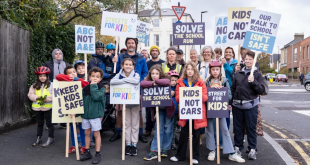
To start with, I’m going to be working on the Streets For Kids campaign, which has been running for a number of years and was started by Anna Becchi.
Anna wasn’t working for Clean Cities when she started a movement in Italy, based around making school streets kind of more child-friendly.
As the initiative has become part of Clean Cities and expanded across different cities, it’s continued to campaign for what are now widely known as School Streets.
Here, you can see there’s a broader picture of child-friendly mobility – we produce a report which gives city rankings based on a group of key, metric-based measures.
Child-friendly mobility is the focus.
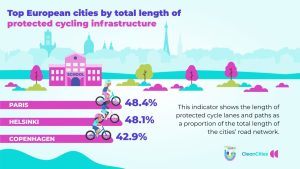
This sees a ranking for 36 cities across Europe for a combination of three different measures.
- One is the number of school streets.
- The second is speed restrictions – so lower speed limits.
- Third is cycling infrastructure.
Possibly not a surprise that Paris came out on top, across the board. London came out top for the number of school streets. The capital has a lot of political will and community support here.
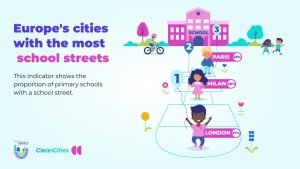
Interestingly, in London, we find School Streets are a temporary measure – just for drop off and pickup time, as this makes it easier to get them implemented, without having to do the whole process of getting a road actually completely closed off, whereas some of the European ones particularly in Italy tend to be they’re permanently being pedestrianized.
So, here we can already see that there’s a real variation as to what a school street is across Europe.
Going back to your original question, one reason for being at Start With Children was to launch this report and the city ranking, then combine that with celebrating the countries and cities that are doing really well, as well as highlighting those who have made really great progress.

Where there’s progress, we also look at what shapes and drives success, exploring opportunities to really spread this friendly, mobility philosophy or school of thought.
One thing that came out of the conference, which is also in the report, which a lot of people have referred back to, is that if you make cities work for children, they actually work for everybody; they work better for people with disabilities, they work better for the elderly, they work better for parents, creating a more inclusive and collective community and inclusive mobility supported environment.
Just saying that, you can imagine the impact of looking through this lens: Instead of making cities designed for cars, or urban areas designed for cars, what happens if you make cities work for children? There are so many society-wide positives to this approach.