 micromobilitybiz Delivering news updates to the micromobility industry, focusing on e-bikes, e-scooters and green transport

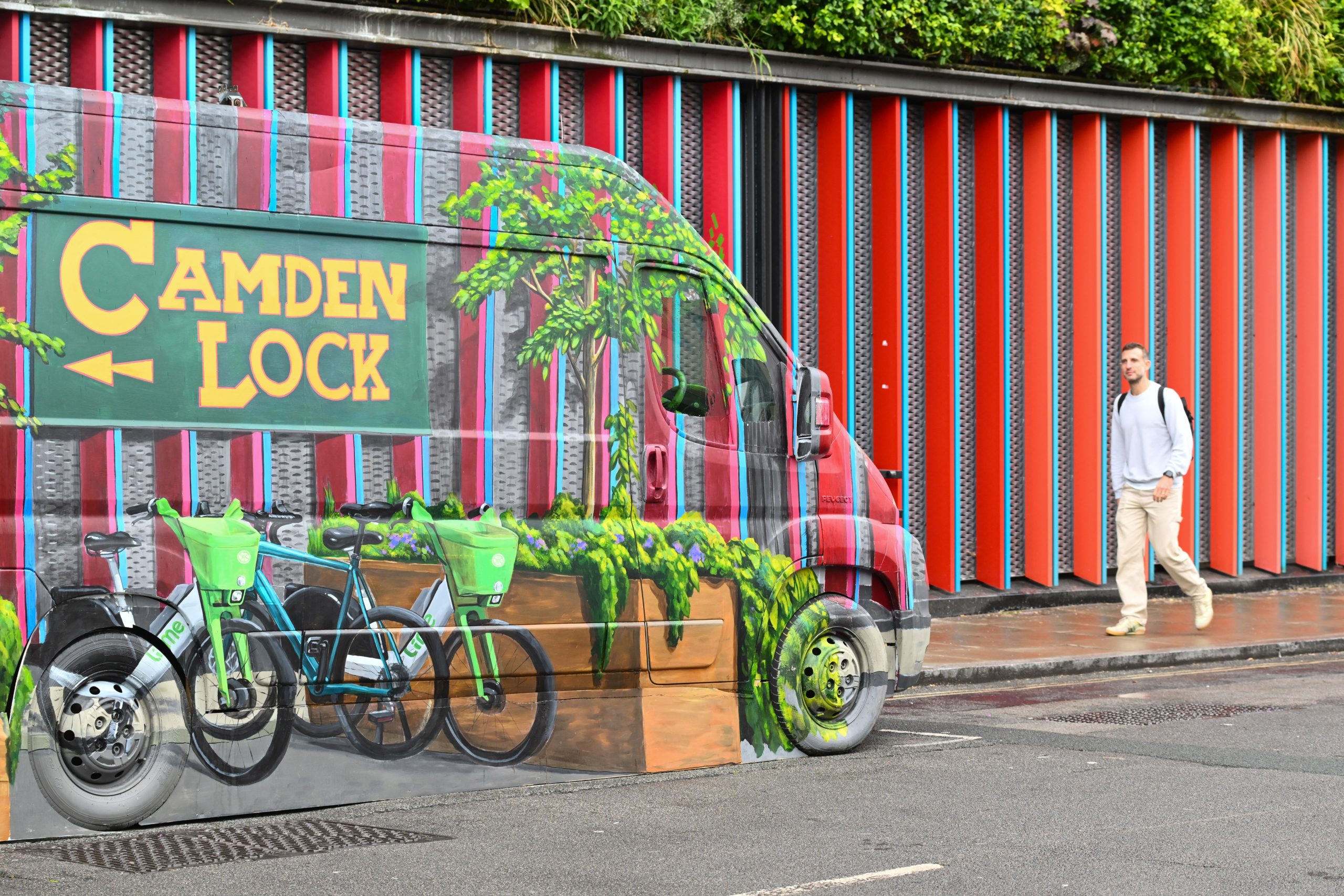
Lime is encouraging Londoners to re-imagine how inner city street spaces could be repurposed to meet growing cycle demand and solve the capital’s e-bike parking challenges through an illusion in Camden.
As Lime trip data shows, an inner London borough like Camden now records approximately 200,000 Lime rides per month, the temporary art installation – designed by 3D street art pioneers, 3D Joe and Max – sees a non-ULEZ compliant 2007 Peugeot Boxer van with more than 150,000 miles on the clock, transform into green space and bike parking as people walk past.
Lime is launching the artwork to bring to life recommendations from a new independent report by transport consultancy, Steer, and advised on by leading think-tank, Centre for London: ‘Changing Spaces: How to solve London’s shared e-bike parking’.
It proposes potential solutions to the insufficient levels of parking locations and inconsistent parking requirements for rental e-bikes across London, as demand for the mode continues to grow exponentially.
It comes as almost half (49%) of Londoners aged 18-34 say they use a rental e-bike at least once a week according to polling in the report.

Despite this uptick, Steer and Centre for London found London misses out on an additional 30,000 emission-free journeys each day – or >10 million per year – as a result of demand for e-bikes rising quicker than space is allocated to bike parking.
Insufficient parking density and capacity can cause clutter on-street, with Lime recording a 21% increase in parking locations with exceeded vehicle capacity in Zone 1 on weekdays in the last six months.
In response, the business has increased its on street staffing by 40%.
By comparison, London’s on-street car parking takes up space equivalent to 10 Hyde Parks, while 25% of London’s carbon emissions come from transport, and half of the city’s air pollution comes from road traffic, according to Centre for London.
Polling for the report found that almost one in three London drivers (29%) leave their cars parked in public on-street locations when not in use, and more than a third (35%) use their vehicles for journeys better suited to green and active travel, under one mile.
The report recommends reallocating some of this space to cycle parking to help reduce car dominance and encourage greener travel, while ensuring London’s streets are tidy and free from pavement obstructions.
As part of an initial audit it identified suitable spaces for at least 750+ new bike parking locations across 11 London boroughs, which could add parking capacity for up to 10,500+ additional rental e-bikes.
This included 163 new locations currently reserved for cars on carriageways or other open spaces that could fit 1,916 shared e-bikes.
According to polling from the report, more than half (52%) of 18-34 year olds in London support the creation of more designated cycle parking spaces.
Hal Stevenson, director of policy for UK&I at Lime, said: “Demand for cycling, including Lime e-bikes, has skyrocketed in the last year, with more people opting for emission-free travel. This growth has come with unintended challenges, and it’s become clear that lack of parking is leading to overcrowded areas that can become obstructive for pedestrians. The report by Steer and Centre for London makes a number of clear recommendations to address this, which Lime is committed to taking.
“Our collaboration with 3D Joe & Max aims to bring these recommendations to life, and inspire a healthier use for London’s parking spaces, where cars often sit idle for days. We’re encouraging people to reimagine how public space could be used and to take action to make our streets better for people and the planet.
“As green, shared transport flourishes, we need to redesign our streets in ways that further encourage this adoption, and disincentive car usage, to meet London’s ambitious climate targets.”


