micromobilitybiz Delivering news updates to the micromobility industry, focusing on e-bikes, e-scooters and green transport

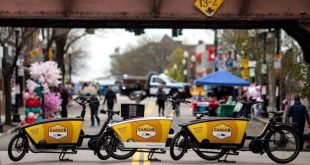
A new Boston-based mobility company has launched CargoB, positioned as the first on-demand electric cargo bike share in the United States of America.
CargoB (pronounced “Cargo-Bee”), is set to redefine urban mobility for around-town trips by providing hassle-free access to a shared fleet of “bakfiets” (pronounced “bok-feets”), translated from Dutch as “box bikes” or “cargo bikes”.
For an American audience, e-cargo bikes are typically associated with the streets of European cities. However, cargo bikes are becoming increasingly popular in bike-friendly cities across the USA due to the ease with which they allow riders to navigate urban neighbourhoods while transporting their families or large loads.
From grocery runs to school drop-offs, e-cargo bikes provide citizens with the capability to opt out of their cars and shift their trips to cargo bikes.
This shift is due, in part, to the rising cost of car ownership, citizens’ desires to reduce climate footprint, and a want to avoid the time-consuming inconveniences of urban driving.
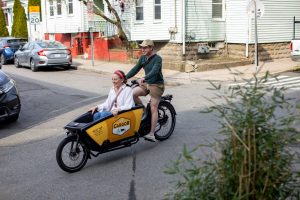
Making the shift to e-bikes accessible and easy
Despite new programmes in many states subsidising electric bike purchases through rebates, the shift to electric cargo bike ownership can still be difficult due to cost, storage constraints, or inconsistent needs.
With the launch of CargoB, Boston residents now have access to on-demand electric cargo bikes as an hourly or daily service, with none of the hassles of ownership.
Co-founders, Dorothy Fennell and Zack DeClerck are Jamaica Plain neighbours who share a passion for e-bikes and offer transportation planning and marketing expertise to the evolving micromobility conversation.
With Boston’s road congestion ranked fourth worst in the world, CargoB offers traffic-adverse citizens a bike-sized mobility option with a comparable carrying capacity of the trunk of a compact car, and at a price that matches the electric BLUEBikes.
When asked, “Why cargo bikes?”, Fennell responds: “The majority of urban car trips are already single occupancy: Why not shift a fraction of those solo drivers from individual cars, onto individual bikes? All we’re doing is providing shared access to a vehicle that’s right-sized for urban living.”
DeClerck follows: “If it fits in the front bucket, and you’re only going across the neighbourhood, wouldn’t you rather skip traffic and CargoB’it?”.
- CargoB bikes are rentable by the minute ($.25) or by the day ($100) – costs are comparable to standard bike share rates.
- Accessing CargoB is as simple as downloading the mobile app for Apple or Android, locating an available bike and scanning the on-bike QR code to unlock.
- CargoB bikes live in conveniently located, designated parking locations
Following a rental, customers return the bike, lock it up and it’s ready to share with the next neighbour.
- CargoB recently launched three on-demand bike locations in Boston’s Jamaica Plain, Cambridge’s Porter Square, and Somerville’s Winter Hill neighbourhoods.
- The company will be launching two additional vehicles at their fourth location in Boston’s Seaport neighbourhood in the near future.
Fundraising, testing the market, and future expansion goals
The bike share company is actively in the fundraising stage and is using this summer to make the case that residents and visitors would prefer to opt out of their cars and hop onto a bike, even when transporting large loads.
Fennell adds: “Initial market research revealed a wide variety of use-cases for cargo bikes and our first couple of weeks are showing both one-time and repeat customers hauling goods for landscaping and other DIY projects, transporting air-conditioners, BBQ grills, groceries, dog park runs with the four-legged housemate, teenagers to appointments, school and activity drop off, and the most environmental trip of all, transporting a Facebook marketplace purchase of an electric lawnmower all the way from Belmont to Roslindale.”
These are all trips that would have otherwise been conducted by car.
But with a fleet of pedal-assisted (non-throttle) electric CargoB bikes, these trips are easy, and, critically, faster by bike – in part thanks to the growing network of bike lanes and mixed-use paths crisscrossing the region.
“When we think about the reasons we love Boston, those heartstrings aren’t pulled by memories of navigating Mass Ave traffic,” says Fennell.
“Instead, it’s the vibrant neighbourhoods, green spaces, and cultural experiences created by the people who live and spend time here. The high-density fabric of our city, one that predates the rise of automobiles, and which tourists flock to enjoy in ‘America’s Walking City’, does not thrive when primarily planned around car-based mobility.”
DeClerck adds: “What you get for the price is not just access to a unique experience, it’s also the freedom from frustration and wasted time stuck in car traffic. If you’re asking yourself if there is a better way to get around town than in a car, the answer is a resounding, ‘yes’ ”.