 micromobilitybiz Delivering news updates to the micromobility industry, focusing on e-bikes, e-scooters and green transport
Portland State University, Sonoma State University, and shared bike and scooter operator Lime, have unveiled a new study examining tax and fee structures imposed on shared micromobility companies and riders across 120 cities in 16 countries.
The study pulls back the curtain on several glaring findings, including that taxes and fees on shared electric bike and scooter operators are on average 23 times higher than the fees and taxes imposed on drivers, on a per-mile basis.
Key findings of the report include:
Shared micromobility is taxed twice—via sales tax and programme fees—and these revenues can be substantial.
On average, cities charging an annual fee receive more than a third of a million USD each year.
If sales taxes/value added taxes (VAT) are included with fees, the average shared micromobility trip generates a fee + tax revenue of $0.70 USD per mile or $0.89 USD per trip.
This can inflate the cost of zero-emissions mobility for riders, as city governments receive 16.4% of the price of every ride via taxes and fees.

Shared micromobility taxes and fees are higher than most other modes of transportation, especially driving and ridehail.
The research team found that fees and taxes on shared micromobility are significantly higher compared to other travel modes, being 23 times higher per mile than personal cars and around five times higher than ridehail trips on average, on a per-mile basis.
This even under-estimates the difference with ridehail. In most US states, ridehail trips are exempt from sales tax and programme fees.
So while the majority of cities impose programme fees on shared micromobility, they receive no tax or fees from ridehail trips, skewing the prices of these two modes in favour of cars over bicycles and scooters.
Fees vary dramatically between cities.
There is no uniform approach to tax and fee policy for dockless shared micromobility.
The most common types of fees are per-trip, per-vehicle, flat annual, and flat one-time fees.
There are large differences in the fee amounts that cities charge – for example, the highest per-vehicle fee is 400 times higher than the lowest.
Conversely, some cities do not impose programme fees at all, in line with municipal transportation goals to reduce traffic, emissions and promote alternatives to driving.
And in some cities, the use of “blind auctions” during competitive procurement processes can increase the cost of providing shared micromobility.
Blind auctions reward operators that make the biggest financial promises, rather than judging applications on their merits, which can lead operators to over-promise on their financial commitment and ultimately deliver poor service, or the closure of the system entirely, because they can’t make the business work.
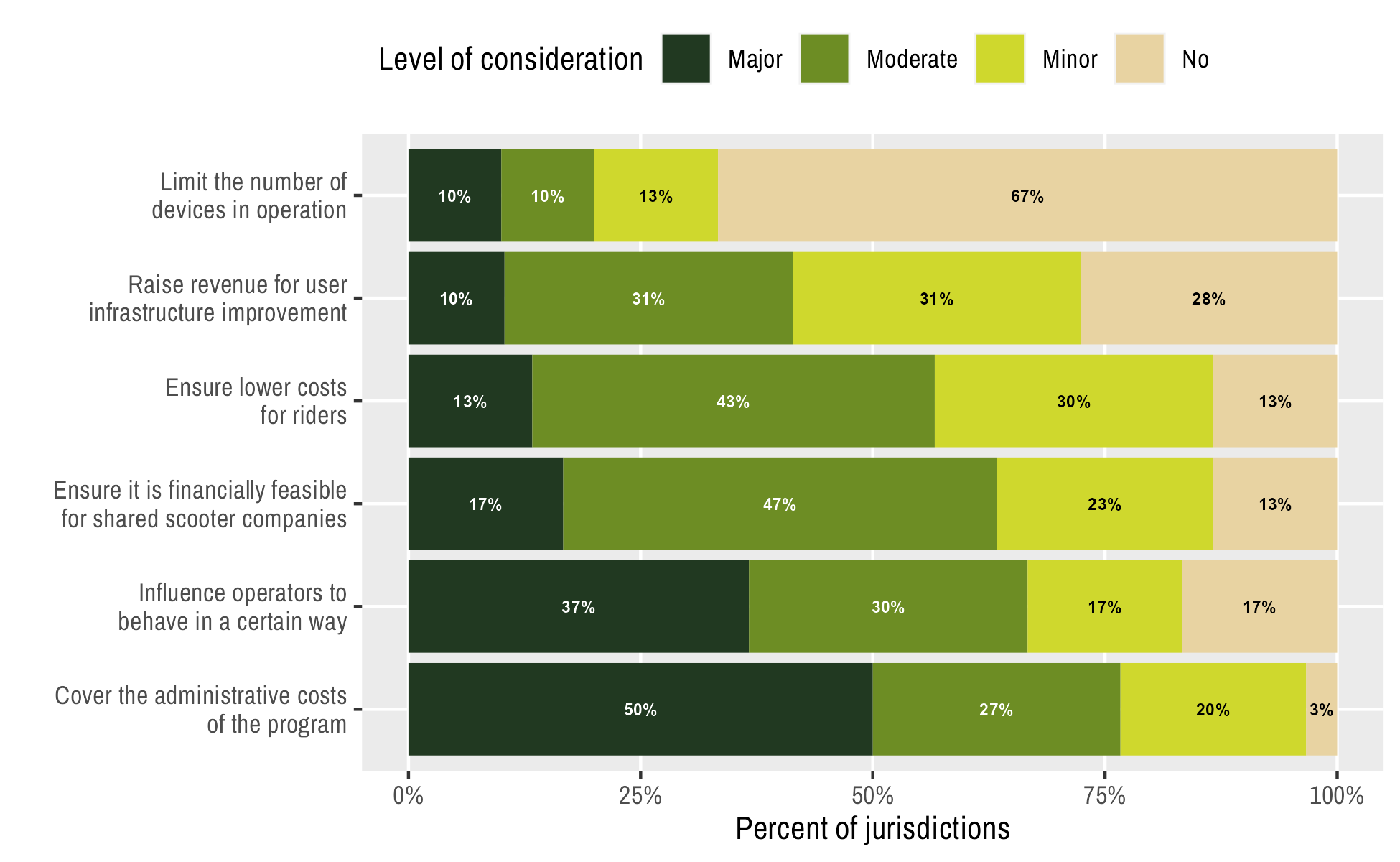
When deciding on fees, cities are especially concerned with covering administrative costs as well as influencing operator behaviours.
The primary use of fee revenue is to cover programme administration costs, rated as the top consideration by 77% of respondents.
Ensuring financial feasibility for scooter companies or lowering rider costs were less prioritised, even though both would extend the impact of shared micromobility programmes.
While cities’ concerns over budget are understandable, this consideration can be at odds with cities’ broader goals for supporting alternative transportation.
Cities’ decisions about programme fees are one of the most consequential choices they can make about their shared micromobility systems.
Higher fees and taxes hurt riders ability to access shared dockless mobility, suppressing demand for these options.
Lower demand in turn impacts the bottom line for businesses already operating on thin margins.
In the last year, there have been several high-profile closures, mergers, and bankruptcies of shared dockless micromobility companies.
When cities increase the cost of business through high programme fees – particularly fees that go well beyond covering the cost of basic administrative oversight – it can impact the financial viability of the industry and put at risk the many benefits shared micromobility provides.
Furthermore, the differences in the negative externalities between shared micromobility and driving are drastic.
Shared e-bikes and e-scooters offer emissions-free travel options that take up far less public space, have a negligible impact on road maintenance costs, and in comparison to cars, have next to zero impact on air quality, noise pollution, or street safety.
So when cities impose fees, it directly contradicts their ambitious goals to reduce carbon emissions, cut down on car traffic, and improve transportation equity.
“This study builds our understanding of a topic that is near and dear to the hearts of cities, riders, and micromobility operators: how to run a system that is affordable for riders while also remaining financially sustainable for micromobility operators,” said Calvin Thigpen, research director at Lime and study co-author.
“In the last six months alone, the industry has seen substantial upheaval through mergers, bankruptcies, and closures.
“So as cities revisit their programme regulations, we hope they take into consideration that the industry has matured substantially since fees were initially established – with safer vehicles, better operations, and closer city collaboration – as well as the role shared micromobility can play in achieving sustainability and equity goals.”

Recommendations
The report outlines a range of principles for cities to employ when considering or reconsidering programme fees:
Policy goals and mode consistency: Travellers are highly responsive to the costs of transport. High fees lead to higher trip prices, which in turn lowers utilisation and decreases the ability of the shared micromobility system to meet cities’ policy goals.
Yet not all shared mobility modes are assessed fees. In many US states, ride hailing is exempt from sales tax as well as fees.
While reaching parity would therefore be a promising start, cities eager to accelerate progress toward their ambitious climate and congestion reduction targets should consider elevating fees on driving to levels commensurate with cars’ numerous externalities.
Simplicity: Complicated programme fee structures are more difficult for cities to administer – they may require a third party to track and provide invoices – and also make it more difficult for shared micromobility companies to forecast their costs.
Simplifying these fees, and how they are collected, can reduce bureaucratic overhead.
Regressivity: Sales taxes and VAT, as well as programme fees, disproportionately affect low-income travellers, which goes against many cities’ goals to improve equity and access to zero-emissions transport.
Double taxation: Riders pay sales tax and VAT on shared scooter and bike trips, meaning that cities with programme fees are imposing a second tax on shared micromobility.
As covered in the study, not every city imposes fees on shared dockless micromobility.

Standouts include Munich, Berlin and Grand Rapids, each of which made the conscious decision to avoid programme fees, to varying degrees, with sustainability, equity and equal distribution of scooters in mind.
The City of Munich’s decision was made in line with its 2025 goal for 80% of trips in the city to be made by zero-emissions modes. Also in line with this goal, Munich does assess fees on shared cars and mopeds.
In Berlin, the City does not assess fees on shared dockless micromobility in the outskirts of the city, only in the city centre.
This contributes to a wider distribution of vehicles in parts of the city with fewer transportation options available.
Fees assessed in the city centre support the establishment of dedicated parking locations to help keep scooter parking tidy.
The City of Grand Rapids underscored their decision not to assess fees in its e-scooter programme RFP, which noted the city’s desire to build a long-term relationship with providers for a high-quality and continuous service aimed at meeting the city’s goals.

Other cities have recently pared back the fees they charge, including Chicago, which in 2022 had the highest per-trip charge of any city in the world.
Earlier this year, Chicago made the decision to cut programme fees considerably, thanks to shared e-scooters contributing to greater transportation access across the city, and their ability to reduce overall emissions stemming from transportation.
“After the boom of shared micromobility in 2017, cities looked at fees as a way to react to this new mode,” said John MacArthur of Portland State University, lead author of the study.
“We see that cities are still setting fees to cover programme administration costs, but also as a way to influence operator behaviour of how they operate their systems in the public rights-of-way.
“Though cities are using fees and taxes to mitigate the cost of programme administration, which is very understandable given local budget constraints, these additional costs to riders can be at odds with a city’s broader goals for supporting sustainable and equitable transportation.”


