 micromobilitybiz Delivering news updates to the micromobility industry, focusing on e-bikes, e-scooters and green transport
EPTTAS and TaiSan today announced a strategic pilot to combine next-generation battery chemistry with advanced AI-based battery safety intelligence for micromobility applications.
The pilot brings together two European deep-tech companies working on the same global problem from opposite sides of the battery system. TaiSan is developing quasi-solid-state sodium battery technology designed to power the next generation of micromobility. EPTTAS is developing Battery Safety Intelligence™ — an independent AI safety layer designed to detect early indicators of battery degradation, abnormal behaviour and thermal runaway risk before conventional alarms become visible.
Battery-powered micromobility is scaling rapidly across cities worldwide. E-bikes, scooters and compact electric vehicles are becoming part of daily commuting, delivery and urban logistics. But as adoption grows, battery safety has become one of the industry’s most visible and difficult challenges. Battery fires are hard to contain, expensive to manage and increasingly important for consumers, operators, insurers, regulators, cities and OEMs.
Most battery safety systems remain reactive. They respond when voltage, temperature, smoke or BMS alarms indicate that failure is already escalating. EPTTAS is building a different approach: a predictive safety intelligence layer using battery telemetry, physics-informed analytics and machine learning to identify risk patterns earlier and create a decision window before visible failure.
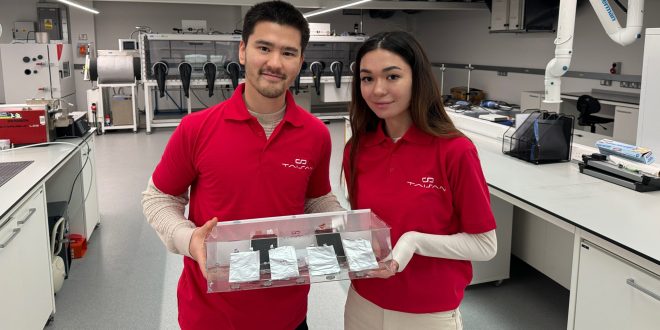
TaiSan does not build bikes or scooters. It builds what powers them. The company is developing quasi-solid-state sodium batteries based on advanced polymer electrolyte technology, aiming to reduce the traditional compromise between performance, cost, safety, weight and responsible sourcing. TaiSan’s battery technology has been positioned as a potential step-change for micromobility by enabling batteries that are smaller, lighter, faster-charging and better suited to compact urban vehicles.
The pilot will explore how EPTTAS’ AI-based Battery Safety Intelligence™ can support TaiSan battery packs with predictive monitoring, risk scoring, diagnostic insight and early warning intelligence. The technical work is expected to evaluate data quality, system integration, model outputs, risk indicators and the potential for future commercial cooperation.
“This is not just another battery pilot. This is about solving one of the defining safety challenges of electrification,” said Robert Eriksen Jacobsen, CEO of EPTTAS. “The world is moving fast toward battery-powered mobility, but safety intelligence has not kept pace with adoption. TaiSan is pushing battery chemistry forward. EPTTAS is building the intelligence layer that can help make batteries understandable before they become dangerous. Together, this pilot is about creating the early decision window the industry urgently needs.”
TaiSan recently won Gold at the Micromobility Europe Startup Awards, where the company was recognised for addressing one of the most fundamental parts of the micromobility value chain: the battery itself. The company’s sodium battery platform is designed to challenge the limitations of today’s battery options, where lithium-ion offers performance but carries cost, sourcing and fire-risk concerns, while first-generation sodium-ion has historically faced weight and size limitations.
“TaiSan does not make the bike or the scooter — we make what powers them,” said Sanzhar Taizhan, Founder & CEO of TaiSan. “Our mission is to advance next-generation sodium battery technology for micromobility and beyond. Safety is central to that mission. Working with EPTTAS gives us the opportunity to explore how predictive AI safety intelligence can support the next stage of battery validation and commercial readiness.”
For consumers, the ambition is safer and more trusted electric mobility. For operators, it is earlier visibility into battery health, charging risk and fleet safety. For OEMs and battery developers, it is a path toward stronger validation, better safety documentation and increased confidence as new chemistries move toward market adoption.
The companies believe the next leap in micromobility will not come from vehicle design alone. It will come from the battery chemistry inside the vehicle — and from the intelligence layer that can understand battery risk before failure becomes visible.
If successful, the pilot may support a broader model for next-generation battery safety: combining advanced European battery chemistry with independent AI-based Battery Safety Intelligence™ for micromobility, electric fleets and future battery-powered infrastructure.